
AI product concept
AI Doesn't Need More Data. It Needs Better Judgment, and So Do You.
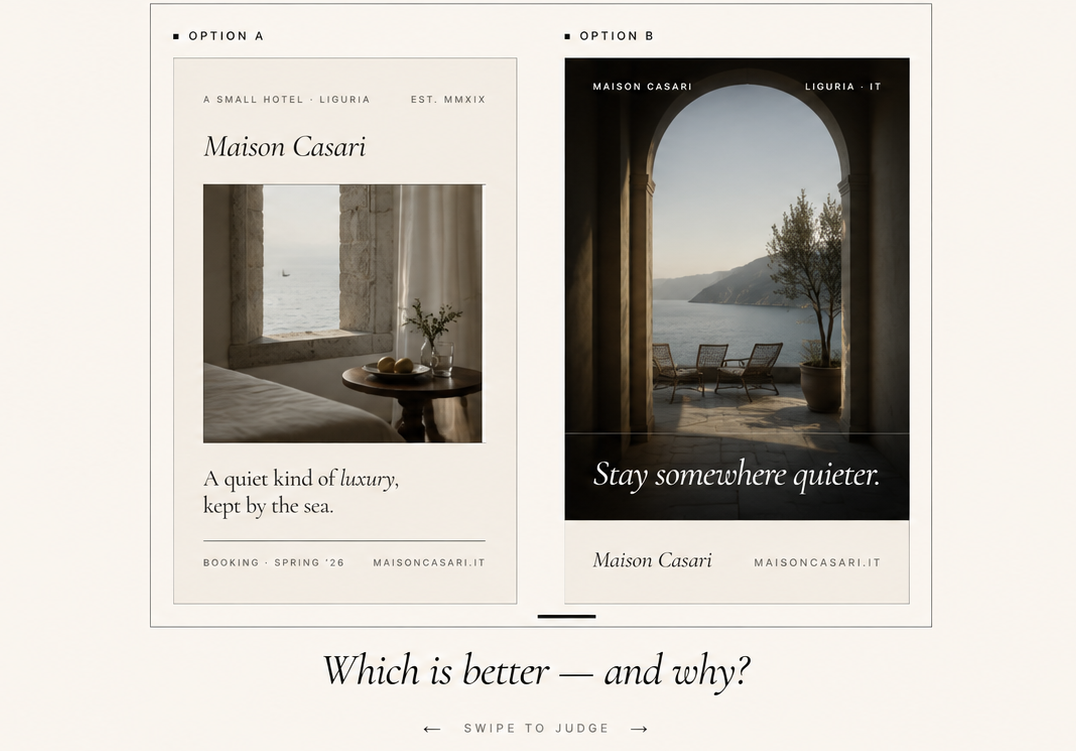
The next era of work won't be won by who has the most AI. It'll be won by who has the best taste using it. This is the tool that trains users on taste — and makes it provable.
A product system for the AI era — turning taste from a soft skill into structured, certifiable judgment by aligning a swipe-based user mechanic, multiple game modes, a certification layer, and optional brand AI integration around one premise: that judgment can be practiced and proven.
Domain: Product + Future
Role: Conceived, defined, designed, architecting
Stage: Concept-stage; in design
Taste Test: a swipe-based judgment app for creatives, hiring managers, and creative team managers navigating the AI era — with optional brand AI integration that teaches the LLM to choose like the team it serves.
AI doesn't need more data. It needs better judgment. And so do you. The people who can prove they have it will keep their craft.
-
The whole industry has converged on the same answer. In the age of AI, taste and judgment are what matter most — for creating work that resonates, and for keeping a career that AI can't flatten.
Everyone agrees on the diagnosis. Almost no one has built the cure.
There's no infrastructure for actually doing the thing — practicing taste, measuring it, proving it, or teaching it to a machine that should think like the team it serves. The conversation has run far ahead of the tool.
So I'm building the tool.
-
The discourse about AI and creative work treats taste as a soft skill — vibes, instincts, you know it when you see it. That framing is the problem. It hands the future to whoever has the most access to AI, not the best judgment using it.
Taste isn't soft. It's a pattern of choices made repeatedly under context. Which means it can be practiced. Which means it can be measured. Which means it can be proven. And — increasingly important — which means it can be exported into a brand's AI so the system learns to choose the way the team would.
That's the premise Taste Test is built on. No one else is building from it yet.
-
Three signals were converging when I started designing this.
The cultural conversation. The industry agreed: production cost is collapsing, taste is the durable advantage, the people who can choose well will keep their craft.
The technical conditions. Brand-tuned LLMs are going from rare to standard. Companies are starting to want their AI to make choices that sound like them, not like generic defaults.
The behavioral pattern. Creatives want to sharpen their own craft. Hiring managers want to evaluate something more reliable than a portfolio. Brand and creative team managers want to onboard new hires and level up existing teams on their brand's specific judgment — fast, in context. Brand operators want their AI to inherit their company's specific judgment.
Everyone is reaching for the same missing piece. I started designing the piece.
-
Four user types, all asking versions of the same question — how do I sharpen, prove, or transfer judgment?
Creatives and creative directors. Actively, intentionally improve your own taste. Build it as a measurable skill rather than an unprovable instinct. Earn certification you can put on a portfolio.
Hiring managers. Evaluate candidates on the thing that actually matters now. Score taste structurally instead of guessing from a deck.
Brand, marketing, and creative team managers. Train the app on your brand's specific judgment first, then use the brand-trained app to onboard new hires and level up your existing team — fast, in context, with a measurable trail of who's matching the brand's taste and where they need work.
Brand operators (extension). Once your team is running Taste Test, export the structured taste data into your own brand AI so the LLM's outputs reflect your team's actual judgment, not generic defaults.
-
The mechanic. Users see a context (audience, goal, scenario) and two or more options, then choose: which is better — and why? Fast, swipe-based, Tinder-speed. The "why" capture is optional and kept fast. Auto-selections where they make sense. Every interaction is structured data: choice + reasoning + audience context + decision logic.
The game modes.
Audience-based — judge with a specific audience in mind (mixed, specified, or — in upgraded plans — fully custom audiences).
Aesthetic-based — no audience context. Pure judgment on composition, lighting, hierarchy, color.
Editing through collage — choose what to keep, cut, or rearrange.
This-or-that picking — the simplest mode, the fastest reps.
The data layer. Every session generates structured data, and that data flows two ways. It sharpens the user's measurable taste profile (their certifiable signal). And in custom programs, it exports into the brand's own LLM, so the AI learns to choose like the team it serves.
Applications.
Individual training & certification — sharpen your own taste; earn portable credentials you can show on portfolios and in hiring.
Hiring evaluation — score candidates' taste structurally; turn the interview from a vibe check into a credential check.
New hire onboarding — train the app on your brand first, then bring new hires up to brand-specific standard fast.
Ongoing team development & brand alignment — keep distributed teams matching the brand's judgment and track improvement over time.
Brand AI tuning (extension) — export structured taste data into your brand LLM so AI outputs reflect the team's actual judgment, not generic defaults.
The tiers.
Free — generic taste-testing, no brand or audience tailoring. For individual practice and general certification.
Paid (custom programs) — tailored to a specific brand, audience, or hiring scenario, plus data export to the brand LLM.
-
The mechanic is the marketing.
Tinder-speed reps mean almost no friction; the act of using it is the act of training. Every session generates data, every session sharpens taste, every session leaves a measurable trail. Nothing else in the category does that.
For individuals, the loop is: practice → measurable improvement → certification you can show.
For brands, the loop is: train the app on the brand → train the team on the brand-trained app → align the brand AI → ship work that sounds like you.
The product doesn't need persuasion. The conversation it's built into is already the loudest one in the industry.
-
Most of the AI conversation treats taste like a soft skill — something creatives have to defend with vibes, and brands have no way to evaluate, train, or scale. Taste Test starts from the opposite premise: taste is structured, measurable, and certifiable. Once it is, the people who have it stop being interchangeable — and the teams who hire them stack themselves with the one skill AI can't flatten.
Certification turns taste from a portfolio claim into a portable credential. Hiring managers get a real signal instead of a guess. Creatives get something defensible when AI threatens to flatten the field. Team and brand managers get a measurable way to onboard new hires fast and lift existing teams on the brand's specific standard.
For teams that want it, brand AI integration is the second unlock. Tune your LLM on what your team would have chosen — the actual judgment of the people who make the work — not the artifacts of past decisions. That changes how brand AI gets built.
-
Where everyone is reaching for the same missing piece, build the piece.
The whole industry is having the same conversation about taste in the age of AI. Everyone agrees on the diagnosis. The cure is uninvented. That gap is the product.
The same logic applies wherever a category is being talked about more than it's being built. When the diagnosis is consensus and the cure is missing, the cure becomes the most valuable thing in the category.
-
The mechanic is the same anywhere consensus is running ahead of infrastructure: an obvious need, an obvious diagnosis, no built tool.
When those three conditions show up, the same shape applies. Read the conversation. Identify the missing piece. Design the artifact that turns the consensus into a practice. Make the act of using it the act of training. Build the data layer that makes the value transferable.
-
I see what's missing in the conversations everyone is having. I design the systems that turn diagnosis into practice — and judgment into something a brand can actually scale.
The next era of work won't be won by who has the most AI. It'll be won by who has the best taste using it. This is the tool that trains users on taste — and makes it provable.