
Cultural brand system
Caviar Was the Trend. Connection Is What People Actually Want.
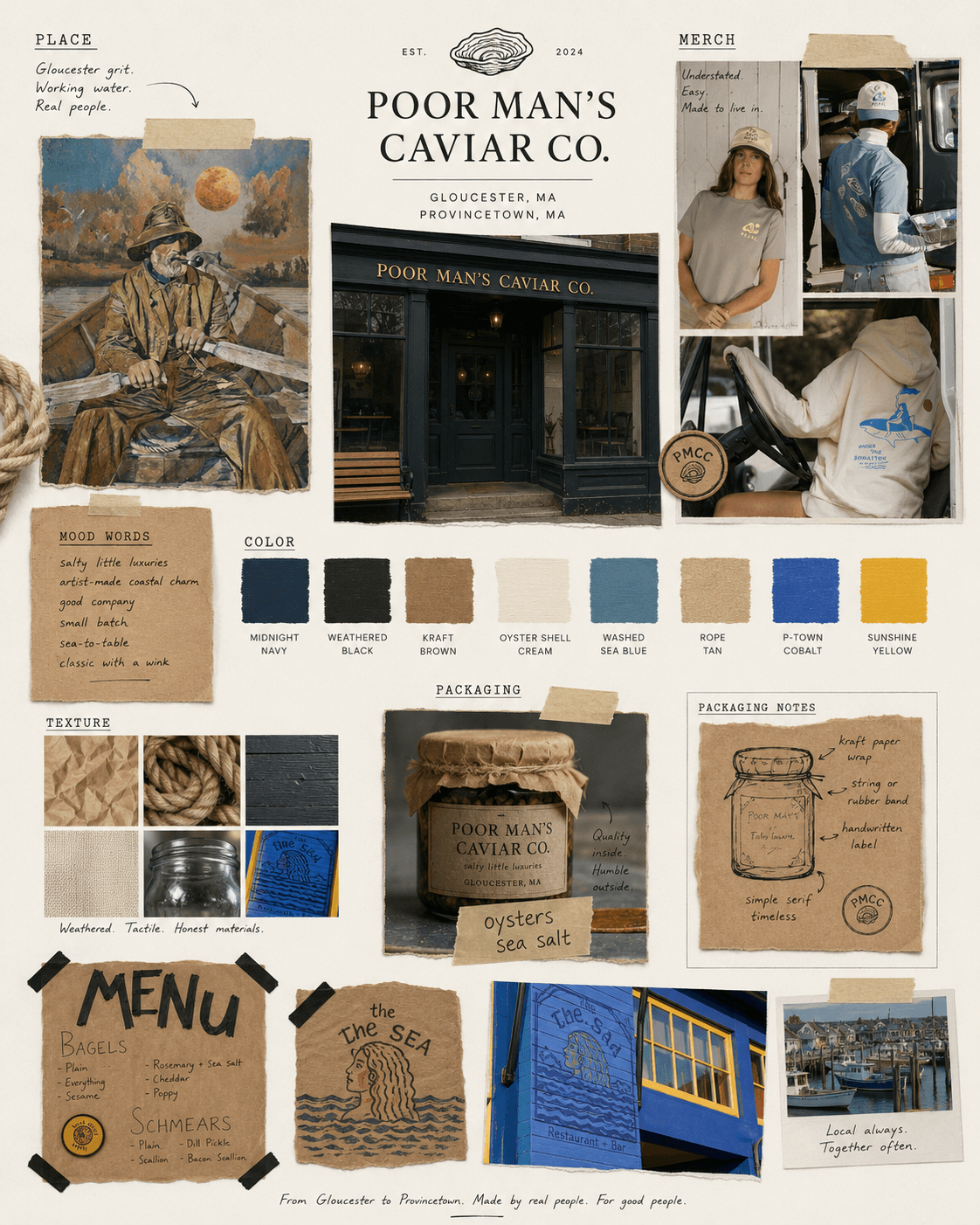
The strongest brands don't follow the surface. They translate the undercurrent into something people can hold. Poor Man’s Caviar Co. is built for the people who already feel the shift — and want somewhere to put it down.
A cultural brand world built around a caviar-style olive tapenade — packaging, playlists, mocktails, prompts, art, and merch, all created with real artists — designed for self-expression, connection, and ritual. One truth holds it together: people are tired of performing. They want to show up as who they really are.
Domain: Brand + Culture
Role: Conceived, named, defined, designed, building
Stage: Concept-stage; in build
Poor Man's Caviar Co.: a cruelty-free, anti-pretentious caviar alternative — and the world being built around it. An olive tapenade plus playlists, mocktails, prompts, art, and merch, all made with real artists. For people who treat community, authenticity, and feeling fully alive as a form of rebellion.
Caviar was the trend. Connection is what people actually want. So we made the brand that just asks them to show up. The people who do — find each other again.
-
Caviar was everywhere. Brunches, Instagram, every "luxury" tasting menu — it had become shorthand for performing taste. But what kept showing up in real life was the opposite. People were exhausted. Tired of performing. Tired of having to spend money to belong. Tired of gatherings being staged for content instead of just lived. What they wanted instead was simpler — to be seen authentically, not staged. To be received without having to earn it.
For the past few years, we were all craving caviar. What people are actually craving is connection and ritual — a return to the sacredness of what we eat, how we eat, and the people we eat with.
The cultural surface was saying more luxury, more exclusivity, more signaling.
The cultural undercurrent was saying please let us just be together — and let us come as we are.
The strongest brands don't follow the surface. They translate the undercurrent into something people can hold. PMC is built for the people who already feel the shift — and want somewhere to put it down.
-
Underneath the trend cycle, the same shift keeps surfacing — the alcohol-free movement, the return to ritual, dinner parties replacing nightclubs, slowness as the new flex, anti-overconsumption pushing back against haul culture, anti-overdesign pushing back against optimized everything.
The pattern is consistent: people are pulling away from performance and toward presence. They want gathering without judgment. Ritual without pretense. A reason to put down the phone that doesn't require dressing up.
Caviar is becoming passé for a reason. It's giving Mar-a-lago. Giving Bezos. Giving everything we're collectively detoxing from — classism, exclusivity, performative wealth, the version of "luxury" that requires someone else to be excluded.
Look at how the audience is responding. Gen Z thinks dupes are cool now — dupes as middle fingers to capitalism, to power hierarchy, to “the man.” People are unassigning the importance they used to place on status goods, designer logos, and what's expensive vs. what's loved. They're getting back down to earth. Reconnecting with each other in real life. Choosing humanity over pomp.
PMC isn't filling a gap. It's tracking what's already happening, and giving it something to hold. A caviar-esque, anti-classism, cruelty-free olive tapenade for people who are over pretending, want to get real, and host judgment-free gatherings.
-
Three signals were converging when I started.
The cultural turn. People were exhausted by performance and reaching for presence. The luxury / scarcity / exclusivity arc had run its course; what people wanted next was simpler, warmer, more honest, more connected — and more in real life, not online.
The category opening. Caviar had primed the cultural appetite for the ritual — a small, sensory, shareable artifact at the center of a gathering. But the ritual had been gatekept by class, price, and pretense. The desire was widespread; the access wasn't. People are reaching for ritual everywhere it shows up — even institutions long out of fashion are having quiet moments of return because we miss having things to gather around. The format was wanted. The gatekeeping wasn't. PMC's job is to bring the ritual back. For all.
The behavioral pattern. People were already assembling rituals piecemeal — mocktails, dinner parties, conversation cards, curated playlists, art on the wall. They didn't need another lifestyle brand telling them how to gather. They needed a delicious thing to put at the center, with a mission they could actually get behind. (Bonus: tapenade doesn't go bad sitting out — let it linger for hours while you talk, create, rest, play.)
That's PMC. A delicious thing with a mission, and the world being built around it.
-
For everyone. Except the assholes who made caviar not fun in the first place. (They can eat PMC, but they'll miss the whole point of it.) People putting on dinner parties, Sunday gatherings, slow Saturdays — who want something at the center of the table that's beautiful, unpretentious, and easy to share. Who are over haul culture and tasting-menu energy. Who'd rather create with friends than perform for them.
The alcohol-free and sober-curious. The mocktail-and-NA-wine crowd — who want gathering rituals that don't depend on alcohol but still feel like an occasion.
Anti-overconsumption gatherers. People rebuilding ritual at home, choosing community over content, presence over performance. Who treat gathering as an act of intention.
Hospitality and brand partners. Boutique hotels, cafés, members clubs, dinner-party caterers, retreat hosts — who want a small brand that brings ritual with it, not just a product to put on the menu.
-
A cultural brand system, not just a product. The artifact is a tapenade; the experience is a ritual.
The product. A cruelty-free, caviar-style olive tapenade. Familiar but elevated. Sensory, shareable, globally inspired in flavor. Body feels good, wallet feels good, environment feels good — the product walks the brand promise instead of performing it. The food is the vehicle for the moment, not the moment itself.
The name as the positioning.Poor Man's Caviar Co. signals what the brand is and what it isn't — accessible, unpretentious, unembarrassed about being affordable. The price point is part of the promise.
The packaging. Brown paper, glass jar, nothing else.
Food brands have been racing each other into Graza-territory minimalism — clean, designed, expensive-looking, all starting to look the same and all starting to feel performative. PMC takes the opposite move: a humble brown-paper wrap, nautical / drunken-sailor in spirit, that arrives with just enough scaffolding to invite participation.
On the inside of the wrap is a guest book, laid out in sections by moment: the arrival. the song that was playing. the conversation. the toast. the goodbye. Light prompts, generous blank space around each. Different people fill different sections — the host, the late arrival, the storyteller, the quiet one. By the end of the night, the wrap is a portrait of the gathering, not one person's craft project. (Tapenade lasts long enough on the table to support the full arc — let it linger for hours while you talk, create, rest, and play, coming back to it to try new assemblies and combinations of your own design each time, delighting with other guests over your discoveries.)
That turns the packaging into a keepsake — a record of who was there, what got said, what got remembered. The brand doesn't ship art. It ships the invitation to make some, together.
Special editions are real artist collaborations: indie artists take over the prompts, redesign the layout, release limited drops. When the product itself is art, occasionally we wrap it in someone else's. Collectible without being precious.
The merch. Sharply-worded, culturally subversive tees, totes, hats, glassware. Sayings that ladder up to the manifesto: community is rebellion; come as you are, and bring the jar. Distributed at farmers markets, in collabs, and via the kind of person who already wears the energy. (Think RS Supply Co. — anti-corporate, real-people-distributed, made for people who already get it.)
The ritual layer. Every flavor arrives with a playlist, a mocktail recipe (add alcohol if you want), conversation prompts, and optional art / vibes for the wall. Each piece is a collaboration: real DJs and musicians making the playlists, real bartenders and mixologists making the mocktails, writers and culturally-tuned hosts shaping the prompts, real artists creating the visuals. The collaborators do the work; the brand brings them together — and brings their audiences in with them. The product unlocks the gathering — it's not just something you eat, it's something you gather around. The shared experience is the ritual.
The brand promise. Cruelty-free food for judgment-free gatherings.
The manifesto. We are tired of performing. Tired of gatherings that have to look good before they're allowed to feel good. Tired of having to pay to belong. Tired of having to be "on."
We don't want a better luxury. We want a different one — to be ourselves, together, and to share meaningful moments and traditions. To be human.
Cruelty-free food for judgment-free gatherings. A small luxury that doesn't ask you to dress up. A reason to put down the phone, light the incense, and let people come as they are.
We believe gathering is a quiet act of resistance. We believe the table is where we come back to ourselves. We believe ritual, abundance, and pleasure belong to whoever chooses them — and the choosing is the whole thing.
Bring the jar. Arrive as you are.
The campaign architecture. Not one launch campaign — a system of repeatable cultural campaigns under one umbrella.
Umbrella: Community as Rebellion. Gathering, hosting, and feeding people without judgment is a quiet act of resistance to a culture that's been quietly robbing us of ourselves, our freedom, and our joy.
Underneath, three sub-campaigns that run year-round:
Just Show Up. Activation campaign. The brand's central permission slip, with double meaning intact: show up in person (at the table, at the beach, on the boat, for the slow Sunday someone bothered to plan) — and show up as you are (no performance required). Hosting kit, playlist, conversation prompts, and a $30-ish challenge anyone can run, anywhere there's a table or a blanket. UGC built in: show us where you showed up. The coolest gatherings of the season win a PMC-hosted dinner party at their place — featuring an indie influencer chef and an IG-known event photographer / videographer who captures everything, so everyone gets to forget about their phones and focus on the moment.
Bring the Jar. Product-led campaign. PMC speaks for itself: the perfect understated thing to bring to a gathering or enjoy alone. Bring the jar — other than that, just come as you are.
Make It Yours. Participation campaign. Every wrap arrives as a guest book by default — the campaign is the invitation to push past it. Top-of-funnel: hyped indie artists releasing limited-edition jar art for special drops, where they take over the layout entirely. Mid-funnel: a public participation contest — paint it, sticker it, scrawl it, wreck it, freak out on it. Show us. The jars become the marketing — and the community of people making them becomes the brand.
Applications.
Hosting at home — a small luxury that makes gathering feel intentional without requiring effort.
Alcohol-free occasions — a ritual the mocktail crowd can build a night around.
Gifting — a thoughtful, anti-corporate gift that comes with a playlist and a reason to use it. More gathering, less gift card.
Hospitality partnerships — a brand-aligned amenity for boutique hotels, cafés, members clubs, retreats, and dinner-party caterers.
Special-edition collaborations — collectible packaging, signature playlists, signature mocktails, custom prompts. A format for artists, musicians, mixologists, writers, and cultural figures whose audiences care about ritual, design, and gathering.
The GTM phases.
Phase 1 — Farmers markets and tastings. Direct sampling, real human interaction, immediate feedback. Build the brand on the most honest channel before scaling.
Phase 2 — Niche-creator seeding and participation contests. Down-to-earth, in-the-know creators seed dinner-party content and decorated-jar moments at the top of the funnel. Public participation contests (Decorate the Jar; Just Show Up — show us where you showed up) carry the middle. The content is the gathering — captured, shared, and scaled by the people who made it.
Phase 3 — Community flywheel. Repeat gatherings, word-of-mouth, creator and micro-influencer seeding. People bring people because the brand made the gathering possible.
-
The product is the reason. The ritual is the reach.
PMC doesn't compete on shelf space — it competes on whose table it's on. The marketing is what people experience when they gather around it: a meal feels different, a conversation goes longer, someone asks about it, the brand walks home with them.
The IRL-to-content loop is the engine. Each gathering produces artifacts: decorated jars, dinner-party tables, candle-lit moments, conversations that went somewhere. Those artifacts become content — scaled by the people who made them, not by the brand. Niche, down-to-earth creators seed at the top of the funnel; public participation contests carry the middle. The brand doesn't manufacture content. It makes the conditions for people to.
That's why the GTM starts at farmers markets, not retailers. Direct contact creates the first ritual; the ritual creates the story; the story does the distribution. Each jar bought is a host inviting four-to-eight people into the brand. The acquisition is the gathering.
The audience this brand is built for doesn't trust ads anyway. They trust the friend who hosted last Saturday and put PMC on the table.
-
Most "anti-luxury" brands argue against luxury and end up still using its grammar — better materials, sharper minimalism, the same posture in different clothes. PMC argues for something else entirely: gathering without performance, presence without pretense, ritual you don't have to dress up for. It doesn't position against caviar. It replaces what caviar was trying to do — mark a moment, make it feel meaningful — and does it warmer, looser, more inclusive.
That shift unlocks more than a product line. It unlocks a brand that can extend into anything that supports the same gathering: glassware, dinner-party kits, retreats, hospitality collabs, ritual goods. The throughline is the truth, not the SKU.
-
When the cultural surface is loud, listen to the undercurrent. Build for what people are actually moving toward.
The trend is what's visible. The undercurrent is what's wanted. Most brands chase the trend and arrive after the cycle has turned. The brands that build for the undercurrent show up as the cycle turns and become the thing the next era wants.
The same logic applies anywhere a category is performing one truth on the surface and another underneath. The job isn't to argue with the trend. It's to translate the undercurrent into something people can hold.
-
This isn't a food playbook. It's a cultural-translation playbook.
When a category is selling performance and the audience is reaching for presence, the brand that wins isn't a better version of the performance — it's the artifact that makes the presence possible. Read the undercurrent. Find the format the surface trend has primed. Strip the gatekeeping. Build the ritual the artifact unlocks. Let people bring people.
The same shape works in any category where the cultural surface and the cultural undercurrent are pointed in opposite directions.
-
I read what people are actually moving toward — beneath the trend, beneath the marketing, beneath what they're saying out loud — and build brands that translate that movement into something they can hold.
When you understand what people actually want, you don't follow trends. You replace them.
Caviar was the trend. Connection is what people actually want. So we made the brand that just asks them to show up – as they are.