
Thought leadership system
We Didn't Launch a Product. We Owned a Question.
The companies winning right now aren't pushing more. They're answering better. This work is what that looks like in practice.
A thought leadership system that turned an emerging market concern into a demand engine for a product launch — aligning audience intelligence, executive POV, content, paid and organic distribution, partner activation, webinar strategy, and sales follow-up around one resonant question.
Domain: Market + Revenue
Role: Conceived, sold internally, directed, and produced
Stage: Launched, scaled, compounding
Tunnl: an AI-powered audience intelligence platform for public affairs agencies, trade associations, and brands navigating high-stakes political and policy conversations.
Webinar recording · Article: retired by Tunnl once the underlying data aged out
We didn't launch a product. We owned a question. And the people who care about that question came to us.
-
Most campaigns push messages. The strongest ones host the question the market is already asking — and become the most credible place to answer it.
ESG was that question. Tunnl's audience — public affairs agencies, trade associations, and brands — was wondering the same thing in different words: How do people REALLY feel about ESG, and what does it mean for our business?
Tunnl's product had an answer. The internal experts had spent their careers holding it. We had a network of well-known, highly credible partners with their own hot takes and offerings for the same audience. The audience was already in the room. The work wasn't to invent demand. It was to align what was already there into one resonant conversation — and become the container for it.
-
The signal showed up before the campaign did.
I'd been watching the space, the market, listening for cues of relevance for Tunnl. The new ESG audiences had to launch successfully, and as always, the Opinion Leaders suite (Tunnl's flagship product) needed to sell, and the system had to precede the product launch — drumming up awareness and credibility so Tunnl’s audience was already paying attention by the time the ESG audiences were ready to buy.
I knew our leaders — and more importantly, the relationships and credibility they already carried. I started seeing those connections the way a strategist sees raw material: alignable resources.
Then I worked the sequence backward. A data-backed thinkpiece by Brent Seaborn (Tunnl's Co-founder and Chief Data Science Officer, and a known thought leader in the data, microtargeting, public affairs, and messaging space) was the easiest internal sell. Once the article performed, I had the proof I needed to get executive buy-in for the bigger move: a webinar with Brent unpacking the topic alongside key partners and opposing voices. Based on observations and on who was engaging with the article, I knew this audience would also be the buyers for the new ESG audiences and, after that, the Opinion Leaders suite.
Executives trusted me to build an entire system based on an observation-backed knowing that I validated with real market insights. That trust was secured by the data underneath the intuition.
-
ESG had passed the awareness threshold. Our audience — public affairs agencies, trade associations, and brands — wasn't asking what is ESG. They were asking how do people REALLY feel about ESG, and what does it mean for our business?
That's a high-value question with money behind it. Three things lined up: people were asking a question, we had a data-backed answer, and we had a related product to launch to the exact people doing the asking. The same audience was also the natural buyer for our flagship product, the Opinion Leaders suite.
-
Public affairs agencies, trade associations, and brands — the people responsible for understanding whether their clients, investors, or shareholders would still be interested in ESG in the months ahead.
A notoriously attention-poor segment: they don't fill out demo forms, they don't read product pages, and they show up only to conversations led by people they already respect.
This same audience was the natural buyer for Tunnl's highly coveted Opinion Leaders suite. Earning their trust on the ESG question opened the door to both: the platform subscription that included the new ESG audiences, and the premium Opinion Leaders add-on.
-
A six-part integrated system designed to compound across audiences, channels, and time.
Audience intelligence. Started from data — what our audience (public affairs agencies, trade associations, and brands) was actually asking about ESG, where their trust already lived, and which products in the Tunnl portfolio could credibly answer.
Seed. A deeply researched, data-backed thinkpiece authored by Brent Seaborn — Tunnl's Co-founder and Chief Data Science Officer, and a known thought leader in the data, microtargeting, public affairs, and messaging space. The article established the position before any brand-led promotion. It also did three things at once: it surfaced high-fit accounts engaging with the topic (which became paid retargeting lists), it gave me the proof I needed to get executive buy-in for the webinar, and it generated organic demand the audience clearly wanted to keep talking about.
Activate. Paid LinkedIn ads to the high-engagement accounts the article surfaced (LinkedIn-only — search wasn't appropriate for the timeline, and our audience was concentrated there). Organic social kept the ESG conversation going through the build phase. Email nurture delivered insights, encouraged continued thought on the topic, and seeded the webinar announcement to the right list.
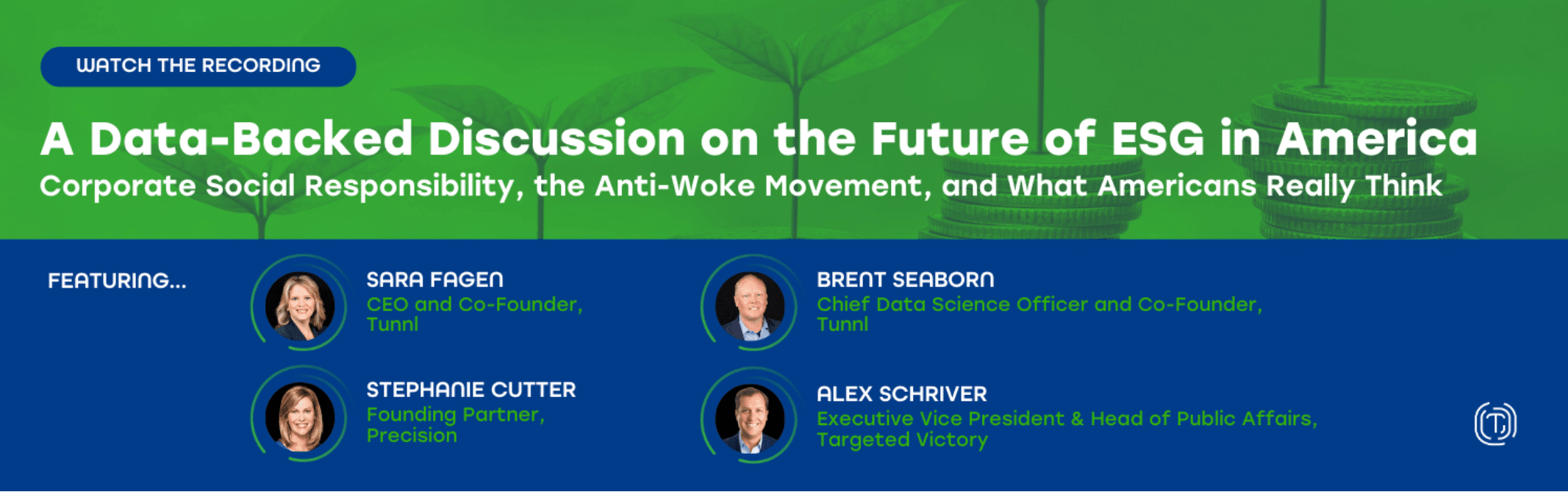
Partner. Internal heavyweights anchored the panel: Tunnl's Sara Fagen and Brent Seaborn. External voices the audience already trusted extended credibility into rooms cold outreach couldn't have entered — including former President Barack Obama's campaign manager, Stephanie Cutter (former co-host of CNN's Crossfire). Their participation lent credibility to Tunnl and our speakers, and their audiences amplified our reach into adjacent circles.
Host the conversation. A live webinar built as a discussion, not a presentation. The format itself signaled what this audience actually wanted: substance over polish, real exchange over scripted talking points, opposing perspectives held in the same room.
Compound. Post-webinar, the recording became a gated resource on the website, generating qualified inbound leads long after launch. Clips ran on social. Email marketing nurtured webinar attendees through the buyer's journey, maximizing the ESG audiences launch and recommending the Opinion Leaders suite to the natural cross-sell audience. The whole motion was designed to keep working.
-
This is where most B2B thought leadership breaks. The content gets made, the campaign goes out, the metrics come in — and three months later, it's archived.
I built this to keep working.
Each stage created the conditions for the next. The article generated the audience signal — proof that our mutual target audience was leaning into the topic, including shared target accounts — which gave us the case to bring partners in (alongside the relationships and reputation our leaders had already built in the space). The conversation became the moment that earned attention. The partners' audiences extended the reach. The recording became the long-tail asset that kept answering the question for everyone who arrived late. And the sales motion underneath turned every interaction into a pipeline event.
The system didn't deliver a message. It built a place the conversation kept happening — and a path from that conversation to revenue. Along the way, it firmly planted Tunnl as a leading voice on ESG in our space.
-
Met our launch sales goals on the ESG audiences. Sold the premium Opinion Leaders suite as the natural cross-sell — same audience, higher-value product. Closed-won revenue on the ESG launch plus closed-won revenue on the Opinion Leaders suite. The whole pipeline moved because we'd earned the right audience's attention on the right question.
The recorded session continued generating qualified inbound leads long after launch. Sales handoffs turned attendance into pipeline that was ready to buy. And buy, they did.
Most importantly: greatly expanded brand awareness and credibility. Firmly planted Tunnl as a leading voice on ESG in our space — public affairs agencies, trade associations, and brands.
A campaign would have ended. This kept compounding.
-
Building this taught me a question I now apply to every positioning system I design.
What question would your audience pay $500,000 to answer? Focus on that.
Most marketing tries to make a smaller thing seem bigger. The real work is finding the highest-value question your audience is already asking, answering it more credibly than anyone else — and selling exactly what that audience needs.
-
The mechanic is the same anywhere: a high-value audience has a question, the company has the answer, and the gap between them isn't content — it's credibility.
When those three conditions show up, the same shape applies. Read the market signal. Recognize the raw material that already exists inside the company. Align it. Bring in partners with shared audiences and aligned interests. Host the conversation. Build the long-tail asset and the sales motion that turn attention into revenue.
-
I read markets, recognize raw material that's already in the building, and build systems that align the two into compounding revenue.
The companies winning right now aren't pushing more. They're answering better. This work is what that looks like in practice.